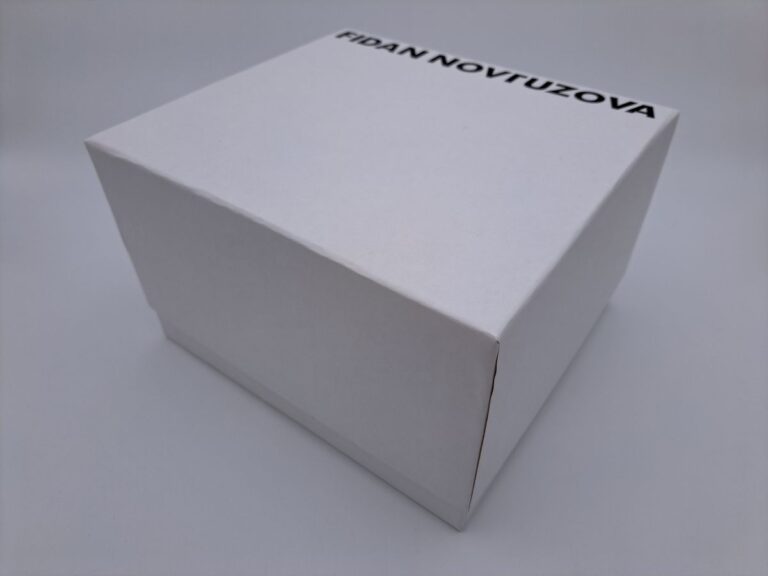
The short answer: a folding (self-assembly) carton is the choice for a product that sells off the shelf in regular runs; a rigid box made of binder’s board is for a product that is gifted, collected or positioned in the top segment. The first wins on economics and logistics, the second on perception. Below is how to choose by criteria rather than by taste.
How they differ structurally
A folding carton is die-cut from sheet cardboard (chrome-ersatz or cellulose board), printed and finished directly, ships flat and assembles in seconds — by hand or on a packing line. Typical structures: flap boxes, crash-lock bottom (folds in one motion), window boxes, euro-slot. A rigid box is built from 1.5–3 mm binder’s board wrapped with a printed sheet, holds its shape permanently and ships assembled — see the detailed guide to binder’s board boxes.
Comparison table
| Criterion | Folding (self-assembly) | Rigid |
|---|---|---|
| Unit price | lower | higher |
| Storage and delivery | flat: compact and cheap | bulky: takes space assembled |
| Packing speed | high, including automatic lines | manual or semi-automatic placement |
| Customer perception | from standard to premium (finishing decides) | unconditionally premium |
| Typical runs | thousands to hundreds of thousands | hundreds to tens of thousands |
| Product protection | sufficient for the shelf | maximum, including inserts |
| Packaging lifespan | until opened | kept and reused for years |
How to choose by product: examples
Everyday-segment wine on a supermarket shelf usually doesn’t need an individual box; a limited series, divin or a gift set with glasses is rigid-box territory — with foil stamping and an insert, the box itself is half the gift. Mass and mid-segment cosmetics — a folding cellulose-board carton with spot UV varnish: a premium look at large-run economics. A luxury line or a set — rigid with soft-touch lamination and a magnetic closure. Confectionery — folding with a transparent window (adds just 2–5% to the box cost): the product sells itself. Jewellery — rigid only: the box stays with the customer for years and keeps reminding them of the brand.
The hybrid path: a folding box that looks rigid
If the budget calls for a folding box but the shelf demands premium, mounting and finishing do the job: dense board, matte lamination, foil on the logo, precise gluing geometry. On Pergament’s servo-driven folder-gluer line (the only one of its class in Moldova), a folding box comes out with the geometry you would normally expect from a rigid one. It is the most underrated compromise: folding-box price, perception a category higher.
Don’t choose from a picture — assemble both
A structural prototype is cut on a plotter in about 30 minutes: order blanks of both versions, put them on the table next to your product and decide with your hands, not your eyes. We will also calculate both configurations in PSystem — compare not only the look but also the price at your run size. Order prototypes.
Frequently asked questions
Which box is cheaper — folding or rigid?
Folding: it is simpler to produce and stores flat. Rigid costs more due to the material, mounting and assembly, but delivers an unconditionally premium perception.
Can a folding box be made premium?
Yes: dense board, mounting, matte lamination, foil stamping and precise gluing geometry give a folding box a look one category higher at a folding-box price.
What should I choose for gift packaging of wine or divin?
For limited and gift series — a rigid lid-and-base or hinged-lid box with a bottle insert; for the regular shelf — a folding box with quality finishing.