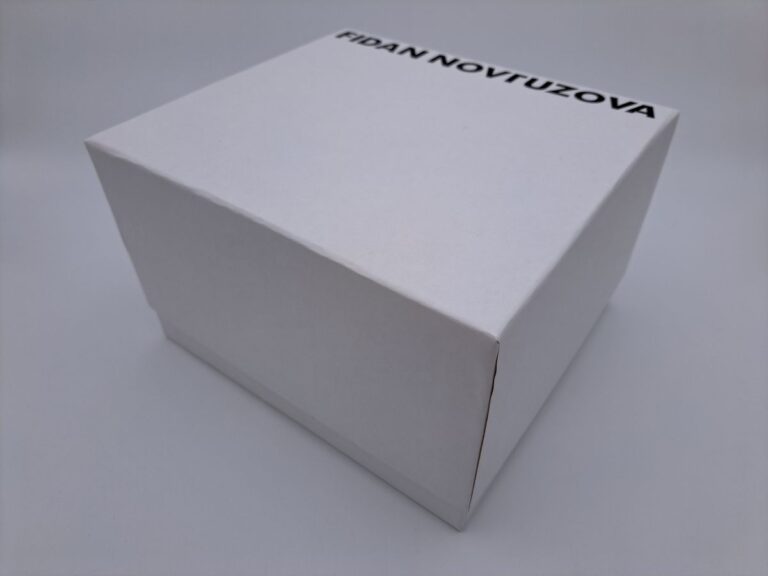
The price of a cardboard box is made up of six blocks: material, preparation (cutting die and design), printing, finishing, die-cutting and gluing, and logistics. Some of these costs are one-off for the whole run, others apply to every unit. That is why a box in a run of 5,000 costs several times less per unit than the same box in a run of 300. Let us break down each block — the way our production management system calculates it.
1. Board and materials
Usually the largest run-dependent item: board type (duplex, virgin fibre, rigid binding board), weight, cutting format. A skilled structural designer saves the most here: the right nesting of the box on the printing sheet reduces waste. Pergament imports materials directly from manufacturers in Europe and Asia — without middleman margins.
2. Preparation: the cutting die and the construction
One-off costs: developing the construction in a CAD system and making the cutting die. There is a legitimate way to save a significant amount here: the Pergament library holds more than 3,000 ready-made cutting dies, and if your box fits an existing construction, no new die is made — you pay only for printing and materials.
3. Printing: make-ready + the run
Offset printing consists of a one-off make-ready (plates, press set-up, getting up to colour) and the run itself. Make-ready costs the same for 500 sheets as for 20,000 — hence the main law of packaging economics: the bigger the run, the cheaper each unit. For small runs digital printing is more cost-effective — see the detailed comparison in “Offset or digital”.
4. Finishing
Foil stamping, UV varnish, lamination, a window — each operation has its one-off part (die, make-ready) and its per-unit part. On medium runs finishing adds only a few percent to the unit price: for example, window patching adds 2–5% to the cost of a box. More detail in “Post-press finishing for packaging”.
5. Die-cutting and gluing
Die-cutting the sheets, stripping the waste, folding and gluing. The speed and stability of this stage depend on automation: on our servo-driven folder-gluer line (1–6 glue points, hot and cold glue) box geometry is as precise as it gets — no gaping flaps or “propellers” that the shopper later sees on the shelf.
6. Packing the run and logistics
Corrugated cases, pallets, delivery. We deliver the run within Chisinau, ship it in batches on a schedule and can store your run in our warehouse — which lets you order a larger (cheaper per unit) run without tying up your own storage.
Why a pre-launch calculation protects your budget
Every order at Pergament is calculated in the PSystem production management system before launch: an operation-by-operation costing of price, cost, deadlines and materials. You can compare several configurations — a different board, different finishing, a different run size — and choose the best one by the numbers, not by eye. And the order’s technological passport guarantees that a repeat run will be calculated and reproduced identically to the first, with no price surprises.
How to save without losing quality: a checklist
Use a ready-made die from the library instead of a new one; choose a box format that nests economically on the sheet; combine similar items into one run to pay for one make-ready; order a run with a seasonal margin (we store it in our warehouse); print the test batch digitally and the main run offset.
Frequently asked questions
Why does a small-run box cost so much more per unit?
One-off costs (die, make-ready, stamping dies) are the same for any run size and are spread across the units: over 300 boxes their share is large, over 5,000 — barely noticeable.
What makes up the price of a box?
Material, preparation (construction and cutting die), printing (make-ready and the run), finishing, die-cutting and gluing, packing and delivery. The one-off part is spread across the whole run, the variable part is counted per unit.
Can I get an exact price before the order is launched?
Yes: PSystem produces a detailed operation-by-operation costing of price, deadlines and materials before launch, including a comparison of several configurations.